
• Home
  • About
  • Resource Centre
    • Topic
    • Refugee Category
    • Region
  • Publications
    • Reports
    • Info-Pages
    • Factsheets
    • Key Statistics & Figures
    • Toolkits
    • Refugee Claim Process Toolkit
    • BC Safe Haven Program – Service Map
    • Work Permit & Job Search Toolkit
  • Training
  • Events
    • Success Stories
  • Contact

Report – Stats Canada: The Long-term Economic Outcomes of Refugee Private Sponsorship

  • Home
  • What’s New
  • Resource Centre Refugee Category Government Assisted Refugees
  • Report – Stats Canada: The Long-term Economic Outcomes of Refugee Private Sponsorship
Refugee Claimant Bulletin // October – December 2019
January 23, 2020
Report – CAMH: Common mental health problems in immigrants and refugees – General approach in primary care
February 6, 2020
Show all

Report – Stats Canada: The Long-term Economic Outcomes of Refugee Private Sponsorship

February 4, 2020
Categories
  • Government Assisted Refugees
  • Key Statistics and Figures
  • Privately Sponsored Refugees
  • Reports
  • Settlement
Tags
  • asylum
  • BC Refugee Hub
  • gar
  • government assisted refugees
  • privately sponsored refugees
  • psr
  • refugee hub
  • refugee report
  • report on refugees
  • statistics canada
  • stats can

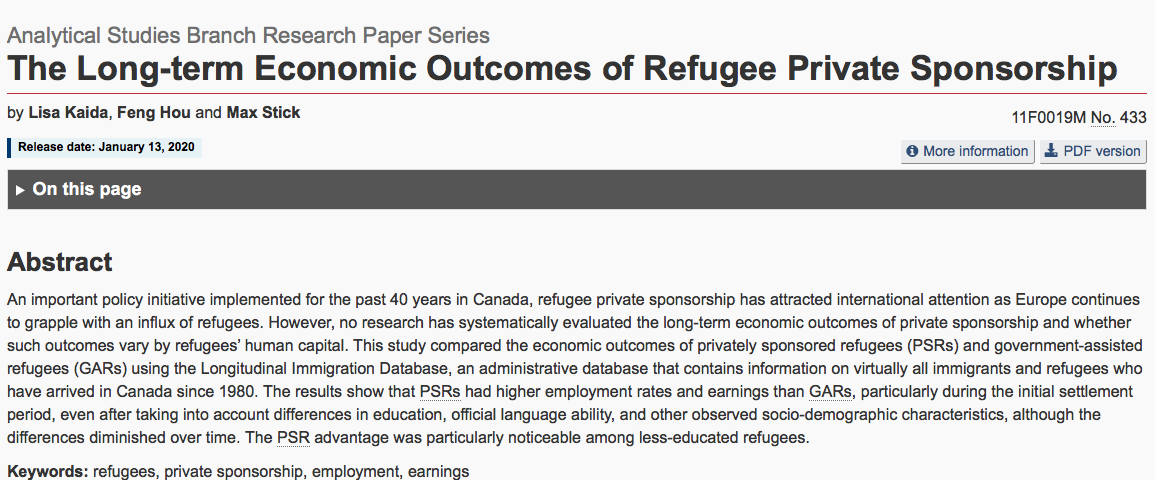
Summary: An important policy initiative implemented for the past 40 years in Canada, refugee private sponsorship has attracted international attention as Europe continues to grapple with an influx of refugees. However, no research has systematically evaluated the long-term economic outcomes of private sponsorship and whether such outcomes vary by refugees’ human capital. This study compared the economic outcomes of privately sponsored refugees (PSRs) and government-assisted refugees (GARs) using the Longitudinal Immigration Database, an administrative database that contains information on virtually all immigrants and refugees who have arrived in Canada since 1980. The results show that PSRs had higher employment rates and earnings than GARs, particularly during the initial settlement period, even after taking into account differences in education, official language ability, and other observed socio-demographic characteristics, although the differences diminished over time. The PSR advantage was particularly noticeable among less-educated refugees.
View complete report here >> 

Share

Related posts

August 19, 2025

Shuswap Immigrant Services Society (SISS) – BC Safe Haven program


Read more
July 29, 2025

KCR Community Resources: Where to Access Free Public Computers in the Central Okanagan


Read more
July 25, 2025

PIRS: BC Park Field Trip to Cypress Provincial Park


Read more

Browse by

  • Events
  • Publications
    • Factsheets
    • Info-Pages
    • Key Statistics and Figures
    • Reports
    • Toolkits
  • Resource Centre
    • Refugee Category
      • Blended Visa Office-Referred
      • Government Assisted Refugees
      • Privately Sponsored Refugees
      • Refugee Claimants
    • Region
      • Caribou-North
      • Fraser Valley
      • Metro Vancouver
      • Thompson-Okanagan
      • Vancouver Island
    • Topics
      • Children
      • Cultural Profiles
      • Education
      • Employment
      • Housing
      • Language
      • Legal
      • LGBTQ
      • Mental Health
      • Primary Healthcare
      • Refugee Policy
      • Settlement
      • Storytelling
      • Women
      • Youth
  • Success Stories
  • Training
  • Uncategorized

Recent posts

  • 0
    Kiwassa Neighbourhood House: English Conversation Club
    November 6, 2025
  • 0
    BC Refugee Hub – Webinar: Understanding the Safe Third Country Agreement (STCA) and Refugee Claimant Eligibility
    November 5, 2025

Join our mailing list to receive regular newsletters from the BC Refugee Hub


JOIN NOW
© 2018 BC Refugee Hub. All Rights Reserved. Website Developed By Blue Tree Project Solutions Inc.

    [text* your-name class:lh-cf7-newsletter-name placeholder "Name" akismet:author]